Table of Contents
- Understanding Augmented Reality in Educational Contexts
- How Augmented Reality Transforms Learning Processes
- Practical Applications Across Educational Levels and Subjects
- Benefits for Educators and Educational Institutions
- Implementation Challenges and Practical Barriers
- Current AR Applications and Tools for Education
- Evidence of Learning Impact and Research Findings
- Future Developments in AR for Education
Augmented reality is fundamentally reshaping how students learn in classrooms across the United States and internationally. Unlike traditional textbooks that present static information, AR technology overlays interactive digital content onto the physical world, allowing students to manipulate 3D models, explore complex systems, and engage with material in ways that dramatically improve comprehension and retention. For students, parents, and education professionals evaluating modern learning tools, understanding AR’s current applications, proven benefits, implementation challenges, and future trajectory is essential for making informed decisions about educational technology investments.
Key Takeaways
- Augmented reality transforms passive learning into interactive exploration by overlaying digital content onto real-world environments through smartphones, tablets, or AR glasses.
- AR applications in education include bringing textbooks to life, enabling virtual field trips, facilitating hands-on science labs, and supporting vocational training with risk-free simulations.
- Educational institutions benefit from improved student engagement, personalized learning pathways, better conceptual understanding, and potential cost savings through virtual resources.
- Implementation barriers include significant upfront hardware and software costs, the digital divide limiting access for under-resourced students, and the need for comprehensive teacher training programs.
- Future AR adoption will likely accelerate through declining hardware costs, integration with artificial intelligence for personalized learning, and initiatives to ensure equitable access across all communities.
Understanding Augmented Reality in Educational Contexts
Augmented reality refers to technology that seamlessly blends digital information with the physical environment in real time. When a student points a tablet at a page in a biology textbook, an AR application might display a beating three-dimensional heart that they can rotate, zoom into, and explore from every angle. This is fundamentally different from virtual reality, which creates an entirely immersive digital environment. AR keeps learners grounded in their physical classroom while enhancing their perception of that space with computer-generated elements.
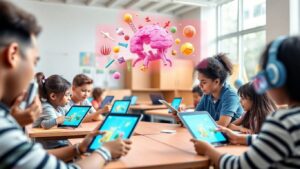
The technology works through several components working together. A device with a camera (smartphone, tablet, or AR glasses) captures the physical environment. Software analyzes what the camera sees, recognizing markers, surfaces, or spatial features. Digital content is then rendered and positioned within that real-world view. This happens in real time, creating the seamless experience where digital objects appear to exist in the actual classroom.
AR differs significantly from other educational technologies. Traditional e-learning platforms deliver content through screens, maintaining a separation between the digital and physical worlds. Interactive whiteboards allow teachers to display content but don’t create the spatial integration that AR provides. AR’s unique strength lies in its ability to contextualize abstract concepts by anchoring them to physical space and allowing direct manipulation of three-dimensional models.
In higher education and K-12 settings, AR is being deployed across multiple subject areas. Medical students use AR to visualize human anatomy during lectures and laboratory sessions. Engineering students interact with AR models of complex machinery. History classes project reconstructed ancient civilizations. Chemistry students safely simulate dangerous experiments. This versatility explains why educational institutions from community colleges to research universities are investing in AR capabilities.
How Augmented Reality Transforms Learning Processes
The shift from passive consumption to active engagement represents the most significant way AR changes learning. Traditional instruction often follows a lecture model where information flows in one direction, from teacher to student. Students read, listen, and sometimes take notes, but their role remains largely passive. AR inverts this dynamic by making students active participants in knowledge construction.
Interactive Engagement and Knowledge Retention
Research in cognitive psychology demonstrates that active engagement with material improves retention significantly. When students physically manipulate three-dimensional models, adjust variables in simulations, and explore content from multiple angles, their brains process information more deeply. An AR anatomy lesson where students rotate a heart model, trace blood flow pathways, and examine it from internal and external perspectives creates multiple neural pathways associated with that knowledge.
This interactive engagement also maintains student attention more effectively than traditional methods. Studies indicate that attention spans in classroom settings are limited, particularly in lengthy lectures. AR experiences provide constant interaction opportunities, keeping students cognitively active throughout lessons. A history class using AR to explore a reconstructed Roman marketplace requires students to make decisions about where to focus, what to examine closely, and what questions to ask, maintaining active attention throughout the experience.
The tactile component of AR learning cannot be overstated. Even though students are interacting with digital content, the physical act of manipulating a tablet or using hand gestures to control AR objects engages motor learning pathways. This multi-sensory engagement creates stronger memories and deeper understanding compared to passively viewing information presented on a screen.
Bridging Abstract Theory and Practical Application
One of education’s persistent challenges is helping students connect abstract concepts to real-world applications. A student might understand photosynthesis mathematically or through textbook definitions but struggle to grasp how this process actually sustains plant life and ecosystems. AR bridges this gap by making the invisible visible and the abstract concrete.
Consider a chemistry student learning about molecular bonds. In a traditional classroom, the teacher draws two-dimensional diagrams on a whiteboard. The student sees these flat representations but may not develop a strong three-dimensional spatial understanding of how atoms actually arrange themselves. An AR application that displays molecular structures as interactive 3D models that students can rotate, pull apart, and reassemble creates genuine understanding. The student can see how atoms position themselves in space, how bonds form at specific angles, and how these arrangements create the properties that determine chemical reactions.
Vocational and technical education particularly benefits from this theory-to-practice bridge. An aspiring electrician learning about circuit design can use AR to see circuit diagrams transform into three-dimensional installations. They can trace the path of electricity through the system and observe what happens when components are added, removed, or modified. This immediate visual feedback between theoretical concepts and practical outcomes accelerates skill development and reduces the risk associated with learning on actual equipment.
Personalized Learning Pathways and Differentiation
Every classroom contains students with different learning speeds, styles, and prior knowledge. Traditional instruction attempts to address this through whole-class instruction followed by individual assignments, but this approach inevitably leaves some students behind while others wait for peers to catch up. AR technology enables genuine differentiation by adapting content delivery to individual student needs.
AR applications can track how students interact with content and adjust difficulty levels accordingly. If a student struggles to understand a concept from one perspective, the AR system might automatically offer alternative visualizations or more detailed component breakdowns. Conversely, students who grasp concepts quickly can access more challenging extensions without waiting for the class to catch up. This responsive differentiation means instruction stays calibrated to each student’s learning trajectory.
Personalization extends beyond difficulty adjustment. Different students benefit from different representations of the same information. Some students are primarily visual learners who benefit from detailed 3D models. Others are more kinesthetic and benefit from manipulating objects. Still others process information better through sequential step-by-step visualization. AR applications can be designed to offer multiple representation modes, allowing each student to engage with content in their preferred learning style while still mastering the same core concepts.
Practical Applications Across Educational Levels and Subjects
AR technology has moved from theoretical possibility to practical classroom implementation across diverse educational settings. Understanding specific applications helps educators and administrators evaluate whether AR solutions fit their particular contexts and student populations.
Science Education and Laboratory Learning
Science education represents one of the most developed AR application areas. Traditional science education faces significant constraints: expensive equipment, safety concerns with dangerous experiments, and difficulty visualizing microscopic or astronomical phenomena. AR addresses all these limitations simultaneously.
In biology courses, students use AR to explore human anatomy at multiple scales. They can zoom from organ systems down to cellular structures and observe physiological processes in real time. A lesson on photosynthesis can display the chemical reactions occurring inside chloroplasts, showing electron pathways and energy transformations that are impossible to observe directly. These visualizations build understanding that textbook diagrams cannot provide.
Physics education benefits from AR’s ability to visualize forces, motion, and energy transformations. Students studying orbital mechanics can manipulate AR models of planets, changing their mass and velocity while observing gravitational effects in real time. This direct manipulation and immediate feedback creates intuitive understanding of physics principles that often remain abstract in traditional instruction.
Chemistry labs pose particular safety and cost challenges. AR simulations allow students to conduct experiments that would be too dangerous (like reactions with toxic substances) or too expensive (like synthesizing rare compounds) to perform with physical materials. Students gain the procedural knowledge and conceptual understanding of these experiments with zero safety risk and dramatically reduced costs. After practicing with AR simulations, students approach physical laboratories with greater confidence and understanding, improving both safety and learning outcomes.
History and Social Studies Instruction
History education has traditionally relied on textbooks, documents, and teacher narratives to help students understand past events and civilizations. AR transforms this by placing students directly into reconstructed historical environments. Rather than reading about the Colosseum, students can use AR to view a three-dimensional reconstruction of the structure in its original condition, understanding its scale, design, and context in ways no textbook description can convey.
Historical simulations enable deeper engagement with cause-and-effect relationships and complex events. A lesson on the American Civil War might use AR to visualize troop movements across a landscape, showing how geography influenced tactical decisions. Students can “rewind” and “replay” historical events from different perspectives, developing more nuanced understanding of how multiple factors contributed to specific outcomes.
AR also addresses a persistent challenge in history education: accessibility to primary sources. While elite universities maintain extensive archives, most students attend schools with limited primary source materials. AR can digitize and preserve historical documents, photographs, and artifacts, making them available to students regardless of geographic location. A student in rural Montana can examine high-resolution AR versions of documents housed at the Library of Congress, deepening engagement with authentic historical materials.
Mathematics and Spatial Reasoning
Mathematics education often struggles with abstract visualization, particularly in geometry and three-dimensional spatial reasoning. Many students who can compute equations struggle to visualize the three-dimensional objects those equations represent. AR makes these abstract concepts visible and manipulable.
Students studying geometry can use AR to rotate complex polyhedra, observing how faces, edges, and vertices relate to each other. Rather than memorizing formulas for surface area and volume, students develop intuitive understanding by physically manipulating 3D objects and observing how dimensions change. This concrete understanding supports more abstract mathematical thinking.
Calculus students struggle with understanding concepts like derivatives and integrals, which fundamentally involve rates of change and accumulation. AR applications that display functions as surfaces or curves in three-dimensional space, allow students to visualize slopes at specific points, and show how accumulated areas represent integrals make these abstract concepts concrete and observable. Students develop mental models that support deeper mathematical thinking.
Language Learning and Cultural Competency
Language education extends beyond grammar and vocabulary to include cultural understanding and authentic communication. AR supports both dimensions by placing language learners in simulated cultural contexts where they practice language while developing cultural competency.
Imagine Spanish language students using AR to navigate a virtual market in Mexico City, with authentic merchants, products, and cultural references. Students must read signs, understand colloquial speech, and respond appropriately to cultural conventions while conducting realistic transactions. This situated learning develops communicative competence far more effectively than classroom role-plays with classmates.
AR can also document endangered languages and cultural practices. Virtual museums and cultural centers preserve indigenous languages, traditional crafts, and cultural ceremonies in immersive formats. Students and community members can explore these materials, supporting language preservation efforts while providing authentic cultural learning resources.
Technical and Vocational Training
Vocational education requires developing practical skills that traditionally demand expensive equipment and present safety risks. AR dramatically reduces costs while improving safety and learning outcomes. Students training for careers in automotive repair, HVAC installation, electrical work, and construction can practice complex procedures repeatedly on AR models before working with actual equipment.
Medical and nursing education particularly benefits from AR-based training. Students can practice surgical procedures, injections, and diagnostic techniques on virtual patients without any risk to real people. This practice builds muscle memory, develops procedural knowledge, and builds confidence before students work with actual patients. Some studies suggest that students who practice procedures through AR simulations before physical practice develop greater competence and require fewer repetitions to achieve mastery.
Benefits for Educators and Educational Institutions
While AR’s benefits for students receive considerable attention, the technology also creates significant advantages for teachers and institutions, influencing adoption decisions and implementation approaches.
Enhanced Teaching Effectiveness and Student Engagement
Teachers consistently report that AR lessons increase student engagement and classroom participation. The novelty and interactivity of AR experiences capture attention in ways that traditional instruction often cannot. However, beyond novelty, AR enables teachers to explain complex concepts more clearly and concisely. Rather than spending minutes describing a three-dimensional structure or process, teachers can display it immediately, saving instructional time while improving clarity.
AR allows teachers to differentiate instruction more effectively without multiplying their workload. Rather than creating entirely separate lessons for advanced and struggling learners, teachers can use AR applications that automatically adjust difficulty and pace based on individual student performance. This responsive differentiation maintains class cohesion while meeting individual learning needs.
Teacher satisfaction and professional development benefit from AR implementation. While initial training requires investment, many teachers find AR tools energizing and professionally rewarding. The ability to facilitate deeper learning and engage students in new ways contributes to teacher satisfaction and reduces professional burnout associated with delivering instruction that feels ineffective to both teacher and students.
Cost Reduction Through Virtual Resources and Simulations
While AR technology requires initial investment, it can reduce ongoing educational costs significantly. Science departments can dramatically reduce spending on laboratory materials by using AR simulations for certain experiments. Field trips, which require transportation, entrance fees, and staff time, can be partially replaced with virtual AR expeditions at far lower cost.
Vocational programs eliminate or reduce spending on equipment for student practice. Rather than purchasing multiple sets of equipment that students practice on and potentially damage, schools can provide AR access to simulated equipment where failure carries no cost. This approach accelerates learning while protecting institutional budgets.
The largest cost reduction comes from extending the lifespan of educational content. Traditional textbooks require replacement every five to ten years. Digital AR content can be updated instantly without replacing physical materials. While digital content requires maintenance and periodic updating, the cost per student decreases dramatically over time as content is used by successive cohorts of students.
Data Collection and Personalized Intervention
AR applications generate detailed data about how students interact with content. Systems track which elements students focus on, what mistakes they make, how long they spend on specific problems, and how they progress through material. Teachers can use this data to identify struggling students before they fall significantly behind, enabling timely intervention.
This data-driven approach to identifying at-risk students is far more precise than traditional methods that often rely on teacher observation or formal assessments that occur infrequently. A student struggling with specific mathematical concepts shows up in AR interaction data immediately, allowing teachers to provide targeted support when intervention is most effective.
Parents benefit from detailed progress reports generated from AR interaction data. Rather than receiving a grade based on a single test, parents can see detailed information about their child’s mastery of specific concepts, areas of strength, and areas needing additional practice. This transparency supports conversations between parents and teachers about appropriate support strategies.
Implementation Challenges and Practical Barriers
Despite AR’s clear educational benefits, implementation faces substantial barriers that determine whether potential advantages translate into actual classroom benefits. Understanding and addressing these challenges is essential for successful adoption.
Hardware and Software Costs
Implementing AR requires significant capital investment in hardware and software that many schools struggle to afford. A comprehensive AR classroom setup typically requires devices (smartphones, tablets, or AR glasses), supporting infrastructure (charging stations, device management systems, possibly improved wifi networks), and software licenses for educational applications.
Cost estimates vary based on implementation scale and technology choices. A basic tablet-based AR program for a single classroom might cost between $5,000 and $15,000 for devices and initial software licenses, excluding installation and teacher training. Schools implementing district-wide AR initiatives might spend $50,000 to $500,000 depending on scale, device choices, and infrastructure upgrades required.
Ongoing costs extend beyond initial purchases. Devices require maintenance, repair, and eventual replacement. Software requires annual licensing fees and periodic updates. Technical support staff may need hiring or professional development to support AR systems. Teachers may require ongoing professional development as applications evolve.
Several strategies help schools manage costs effectively:
- Phased implementation: Begin with pilot programs in select classrooms or grades, proving value before scaling district-wide. This approach manages budget constraints while generating evidence supporting larger investments.
- Grant funding: Federal programs (like STEM education grants), state education agencies, and private foundations (particularly those focused on educational technology or STEM education) provide grants specifically for educational technology implementation. Schools can often fund initial AR implementation entirely through grants.
- Device sharing models: Rather than providing individual devices to every student, schools can establish shared AR stations, classroom sets of tablets, or bring-your-own-device programs where students use their personal devices. This reduces per-student costs significantly.
- Open-source solutions: Free and low-cost AR applications are increasingly available, reducing software licensing costs. Teachers can use these free tools to develop basic AR content without expensive proprietary platforms.
- Long-term cost analysis: While upfront costs are significant, schools should calculate total cost of ownership over five to ten years, accounting for cost reductions from eliminated textbook purchases, reduced field trip expenses, and reduced laboratory material costs. Over extended timeframes, AR often proves more cost-effective than traditional approaches.
Addressing the Digital Divide and Equity Concerns
Not all students have equal access to technology outside school. Students from low-income families may lack smartphones or tablets at home. Rural students may have insufficient internet connectivity for downloading AR applications or streaming video content integrated into AR experiences. English language learners may require interface accommodations that AR applications don’t always provide.
If schools implement AR programs without addressing access inequities, they risk widening achievement gaps. Students with technology access at home can practice AR-based lessons, deepening learning outside school. Students without home access cannot, amplifying advantages for affluent students. This represents a particularly serious concern given that equity is a primary educational goal.
Addressing equity requires intentional strategies:
- Device lending programs: Schools can lend AR-compatible devices to students who lack them at home, ensuring all students have equal access. Clear checkout and return procedures, along with device cases and insurance, protect against damage and loss.
- In-school access emphasis: Design AR implementation so that primary learning occurs during school hours when all students have guaranteed access. This prevents home access disparities from affecting learning outcomes.
- Offline content availability: Develop AR experiences that download fully onto devices, allowing use without internet connectivity. This supports students with limited home internet access.
- Accessibility features: Ensure AR applications include closed captioning, audio descriptions, keyboard navigation, and high-contrast visual modes. These features benefit students with disabilities while supporting diverse learning preferences.
- Community partnerships: Partner with libraries, community centers, and after-school programs to provide AR access outside school. This extends learning opportunities while building community technology capacity.
Teacher Preparation and Professional Development
Technology alone doesn’t improve learning. Teachers must understand AR tools, know how to integrate them into curriculum, troubleshoot technical problems, and adapt instruction based on how students interact with AR content. Many teachers enter the profession without AR experience and feel uncertain about implementing new technology effectively.
Effective professional development for AR implementation requires more than one-time training sessions. Teachers need initial training covering device operation and basic application use, but more importantly, they need ongoing support addressing how to integrate AR into their specific subject areas and grade levels. They need pedagogical training on how to facilitate learning with AR rather than simply using AR as a novelty. They need communities of practice where teachers share successful strategies and problem-solve challenges together.
A comprehensive teacher preparation approach should include:
| Professional Development Component | Time Commitment | Key Outcomes |
|---|---|---|
| Initial technology training | 8-16 hours | Teachers can operate devices, launch applications, and perform basic troubleshooting independently. |
| Curriculum integration workshops | 12-20 hours | Teachers design lessons integrating AR meaningfully into their curriculum, not as replacement for quality instruction but as support for learning objectives. |
| Pedagogy and facilitation training | 6-10 hours | Teachers understand how to facilitate active learning with AR, ask productive questions, and assess student understanding during AR activities. |
| Content creation basics (optional) | 10-20 hours | Teachers create simple AR content adapted to their specific classroom context, extending beyond off-the-shelf applications. |
| Ongoing support and communities of practice | Continuous | Teachers troubleshoot problems, share successful strategies, and continuously improve AR integration in their instruction. |
Schools should budget approximately 40-60 hours of professional development time per teacher for comprehensive AR implementation. This seems substantial but represents far less time than teachers typically spend on other major instructional changes. The investment repays itself through improved classroom effectiveness and more confident, satisfied teachers.
Technical Limitations and Content Quality Variability
Not all AR applications are educationally sound. Some applications prioritize novelty or entertainment value over learning effectiveness. Graphics quality varies widely, with some applications offering realistic renderings while others provide crude representations that don’t accurately depict concepts. Content accuracy is not guaranteed; some AR applications contain scientific inaccuracies or oversimplifications that mislead students.
Schools evaluating AR applications should establish clear criteria for selection, including verification of content accuracy, alignment with learning standards, appropriate difficulty levels, and evidence of learning effectiveness. Rather than adopting applications primarily based on cost or graphics quality, schools should pilot applications with students, collect data on learning outcomes, and gather teacher feedback before committing to district-wide implementation.
Current AR Applications and Tools for Education
Several major AR platforms and applications serve educational contexts, each with distinct strengths and appropriate use cases.
Platform Options and Selection Criteria
Schools evaluating AR solutions face numerous options with varying costs, features, and learning curves. Selection should align with specific educational goals and institutional capacity.
Google Expeditions AR provides virtual field trip experiences with high-quality 360-degree imagery of museums, natural wonders, historical sites, and other educational destinations. Teachers can guide students through expeditions while highlighting specific features. The platform requires only Android devices or iPhones and basic internet connectivity. Cost is minimal (many features are free), making this an accessible entry point for schools exploring AR.
Merge Cube and Merge EDU offer tactile AR experiences where physical cubes serve as markers for digital content. Students hold a physical cube while viewing AR content that appears on their device. This combination of physical manipulation and digital visualization creates particularly strong engagement. Merge EDU provides curriculum-aligned content across STEM and social studies subjects. Merge Cube hardware costs approximately $15 per device, with subscription costs for teacher resources and advanced features.
Anatomy 4D and Anatomy VR provide detailed human anatomy models supporting biology and health sciences education. Students can explore body systems at multiple scales, from organisms down to cellular structures. These applications are particularly valuable for medical and nursing programs but also support high school biology education. Licensing costs vary based on institutional size and usage scope.
Unimersiv provides immersive educational content across multiple subjects including history, science, and languages. Content can be experienced through AR (on tablets and smartphones) or as fully immersive virtual reality experiences. The platform emphasizes guided learning experiences rather than free exploration, supporting structured lesson development.
ARCore and ARKit are development platforms that allow educators and technology specialists to create custom AR applications aligned with specific curriculum needs. While these platforms require technical expertise, they enable creation of specialized content that commercial applications may not provide. Open-source AR frameworks are also available, though they require greater technical capacity to implement.
Selecting the Right Solution for Your Context
Schools should evaluate AR options against these criteria:
- Curriculum alignment: Does the application directly support learning objectives in your courses? Does content align with standards you’re required to teach?
- Device compatibility: What devices does the application require? Does it work with the devices your school already owns or can afford to purchase?
- Internet requirements: Can content be downloaded for offline use, or does it require continuous internet connectivity? This matters particularly for schools with limited bandwidth.
- Accessibility features: Does the application include closed captioning, audio descriptions, and interface customization supporting diverse learner needs?
- Teacher support: Does the vendor provide training, curriculum guides, and ongoing technical support? What is the learning curve for teachers adopting this tool?
- Cost structure: What are upfront costs, ongoing licensing fees, and per-student costs? Are there volume discounts for district-wide implementation?
- Evidence of effectiveness: Has research demonstrated that this application improves learning outcomes? What do educators using this tool report about student achievement?
- Content quality: Is content accurate and presented at appropriate complexity levels? Does the visual quality accurately represent concepts being taught?
Rather than selecting a single platform, many schools adopt multiple tools serving different purposes. One platform might provide virtual field trips, another supports anatomy education, and another offers language learning experiences. This diversified approach reduces dependence on any single vendor while leveraging each tool’s particular strengths.
Evidence of Learning Impact and Research Findings
While AR’s educational potential is clear, what does research actually show about learning outcomes? Understanding evidence of effectiveness is important for decision-making and for setting realistic expectations.
Studies examining AR’s impact on student learning generally show positive results, but effect sizes vary considerably based on implementation quality. A meta-analysis of AR in education found average effect sizes in the moderate range when AR replaced traditional instruction, with larger effects observed when AR was used to supplement traditional instruction thoughtfully rather than as a replacement.
Research indicates particular benefits in specific areas. Students using AR to explore three-dimensional structures (molecules, anatomical systems, geometric shapes) demonstrate significantly improved spatial reasoning compared to students viewing two-dimensional representations. Students engaging with AR simulations show improved conceptual understanding of complex processes compared to passive observation of video demonstrations. Students using AR for procedural training (vocational skills, medical procedures) show accelerated skill development and improved retention compared to traditional practice methods.
The Bottom Line
However, research also identifies conditions under which AR fails to improve learning. When AR is used primarily for novelty without meaningful pedagogical integration, the initial novelty fades and learning benefits disappear. When AR content is inaccurate or presented at inappropriate complexity levels, it can mislead students or frustrate them. When teachers lack proper training in facilitating AR learning, they may underutilize the tool’s potential or use it in ways that don’t support learning objectives.
The most consistent finding across research is that AR itself doesn’t improve learning; rather, thoughtful implementation of AR within sound instructional design improves learning. This emphasizes that AR is a tool requiring skilled use, not a magic solution solving educational problems automatically.
Future Developments in AR for Education
Technological Advances and Hardware Evolution
Current AR implementation relies primarily on handheld devices like tablets and smartphones. While these work well, next-generation AR glasses promise more immersive and intuitive experiences. Devices like Microsoft HoloLens, Magic Leap, and emerging alternatives from other manufacturers offer hands-free interaction where gestures and voice commands control AR content. These devices potentially reduce physical barriers to access and engagement, though current costs (often $1,000 to $3,000 per device) remain prohibitive for most educational settings.
Costs for AR glasses are declining as technology matures and manufacturing scales up. Within five to ten years, schools may access quality AR glasses at price points comparable to current tablet costs. This would transform AR implementation by enabling simultaneous group engagement with shared AR experiences rather than individual handheld device interaction.
Improvements in AR tracking and display technology will enhance visual quality and expand possibilities for complex simulations. Current AR applications sometimes struggle with accurate spatial tracking or rendering quality limitations. Future improvements will support more sophisticated applications with photorealistic rendering and stable tracking even in challenging lighting conditions or complex environments.
Integration with Artificial Intelligence and Adaptive Learning
Combining AR with artificial intelligence creates genuinely adaptive learning systems that personalize instruction to individual student needs. AI algorithms analyzing student performance can generate customized AR content targeting specific misconceptions. If a student struggles understanding molecular bonding, an AI system could generate additional AR visualizations focusing specifically on that concept, presented at that student’s appropriate difficulty level.
AI-powered tutoring integrated with AR offers particularly promising possibilities. Rather than navigating AR applications independently, students interact with AI tutors that guide exploration, ask probing questions, and provide tailored feedback. This combination leverages AR’s ability to visualize complex concepts with AI’s ability to provide responsive, personalized instruction.
Natural language processing improvements will make AR interfaces more intuitive. Rather than navigating menus and buttons, students will control AR content through conversation, asking questions and requesting specific visualizations verbally. This conversational interface will make AR more accessible to younger students and those with motor skill limitations.
Social and Collaborative AR Learning Experiences
Current AR implementations often focus on individual student interaction with content. Emerging capabilities will enable shared AR experiences where multiple students simultaneously interact with the same AR environment. Imagine a history class where all students simultaneously explore a shared AR reconstruction of ancient Rome, able to point out features to each other and discuss what they observe. Or a science class where students collaboratively manipulate molecules in a shared AR workspace, discussing bonding configurations in real time.
These collaborative AR experiences could be particularly powerful for developing communication and collaboration skills alongside content mastery. Students learn to articulate their thinking, listen to peers’ perspectives, and negotiate shared understanding while working with rich visual representations that support discussion.
Addressing Equity and Access Challenges
Future AR implementation must intentionally address current equity gaps. This requires sustained attention to device access, ensuring all students have genuine access regardless of family income. It requires development of culturally responsive content reflecting diverse perspectives and experiences rather than generic or